
Sliding glass doors are one of the most architecturally interesting — and practically challenging — features in any home. They flood a room with natural light, connect indoor and outdoor living, and create a sense of openness that few other design elements can match. But without the right covering, that same door becomes a source of lost privacy, uncomfortable heat gain, and visual clutter.
After testing multiple window treatment options across different home styles — from a sun-facing living room that turned into a greenhouse every afternoon, to a bedroom where streetlights made sleep nearly impossible — I have learned exactly what works, what fails, and what is genuinely worth the investment.
This guide covers 17 sliding glass door covering ideas with honest, detailed advice. Not just aesthetics — but real-world performance, cost considerations, and installation tips that most articles skip entirely.
Why Choosing the Right Sliding Glass Door Covering Is a Structural Decision
Most homeowners treat window coverings as decor. That is a mistake.
A sliding glass door is typically 6 to 8 feet wide and 6.5 to 8 feet tall — often the largest single opening in a home’s envelope. According to the U.S. Department of Energy, uncovered glass surfaces account for 25 to 30 percent of residential heating and cooling energy loss. In practical terms, a bare sliding glass door in a west-facing living room can raise room temperature by 10 to 15 degrees Fahrenheit on a summer afternoon.
Beyond energy, there are three other factors most guides ignore:
Door clearance: Your covering must not obstruct the door’s sliding path. Treatments that stack too tightly in front of the frame will create daily frustration.
Weight distribution: Heavy curtain systems need properly anchored rods or tracks — drywall anchors alone are insufficient for wide-span installations over 72 inches.
Light-to-privacy ratio: These are often competing priorities. The best treatments let you adjust both independently, not sacrifice one for the other.
With that context, here are 17 options — honestly reviewed.
17 Stunning Sliding Glass Door Covering Ideas
1. Sheer Linen Curtains
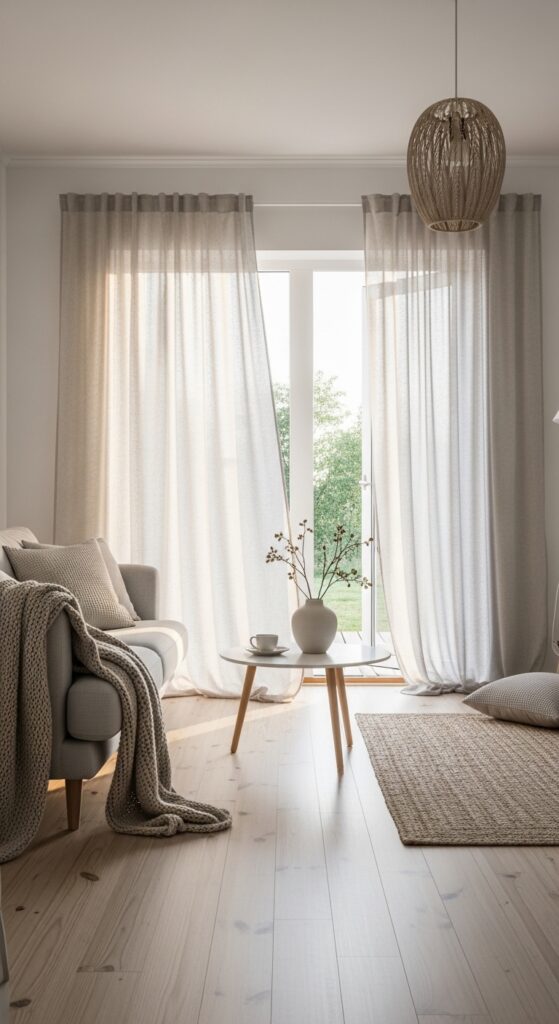
Best for: Soft privacy, light diffusion, coastal or Scandinavian interiors
Sheer linen curtains remain one of the most versatile choices for a sliding glass door. The open weave scatters direct sunlight into a diffused, warm glow rather than blocking it — a significant advantage in rooms where you want natural light without harsh glare.
The key installation mistake people make is hanging the rod at door-frame height. For a proportional, designer look, mount your rod 6 to 8 inches above the frame and extend it 10 to 14 inches on either side. This elongates the visual height of the door and allows the curtain to clear the door opening fully when pulled back.
For nighttime privacy, sheer linen alone is insufficient — you will need a blackout layer behind it. A double-rod system handles this elegantly and costs $25 to $60 for the hardware alone.
Material note: True linen sheers breathe well and drape beautifully, but wrinkle more than polyester-linen blends. If a relaxed, lived-in look bothers you, choose a blend.
2. Vertical Blinds with a Modern Twist — Classic, Functional & Updated
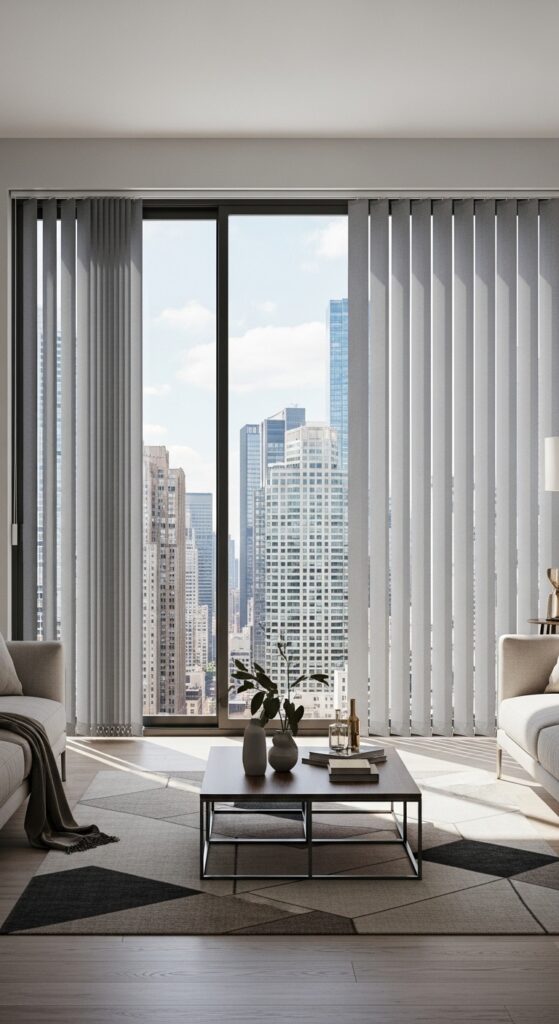
Best for: Precise light control, rental properties, households with pets or children
The vertical blinds of 2024 bear almost no resemblance to the brittle plastic versions of 25 years ago. Today’s fabric, faux wood, and textured vane options drape cleanly and operate smoothly — and they remain the most functionally practical option for a sliding glass door because each slat rotates independently.
The specific feature worth seeking out is S-curved vanes. Unlike flat vanes, S-curves hang with a subtle wave that eliminates the visible gaps between slats when light hits them at an angle — a common complaint with older designs.
For cleaning, a microfiber glove dusted over each vane takes about three minutes per door. This matters more than most people expect in high-traffic rooms with cooking odors or pet hair.
Avoid cheap chain-linked bottom weights. They tangle and break. Look for sets with individual bottom weights or no weights at all, which hang more cleanly.
3. Panel Track Blinds — The Sleek, Minimalist Alternative
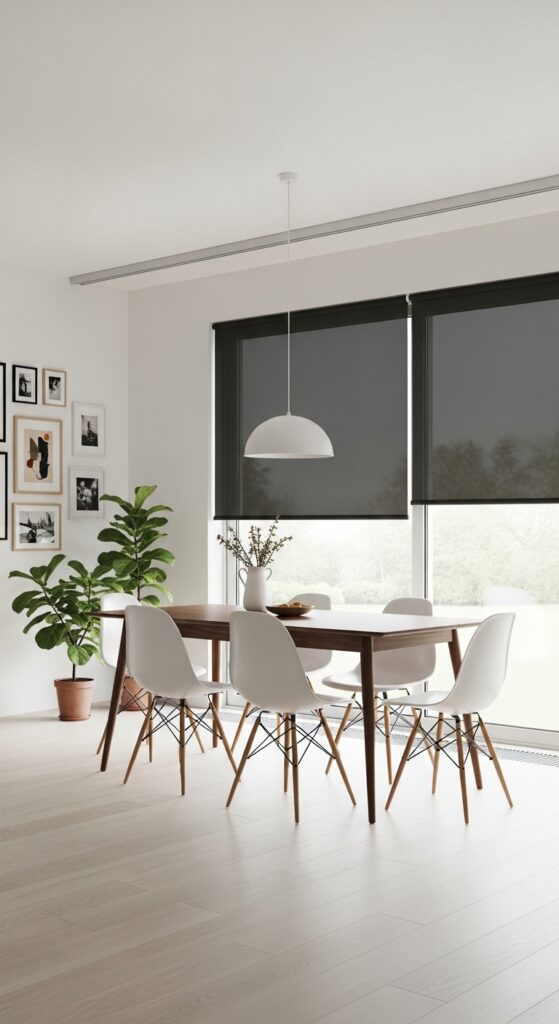
Best for: Minimalist and contemporary interiors, large doors over 72 inches wide
Panel track blinds operate on a ceiling-mounted or header-mounted track and slide open in overlapping panels — similar in concept to a sliding door itself. For very wide glass doors, they solve the stacking problem that vertical blinds create (which bunch heavily to one side).
A three-panel configuration typically works best for standard 6-foot doors. Four panels suit 8-foot openings. The panels stack behind one another when open, consuming 12 to 18 inches of wall space per panel depending on fabric thickness.
The most underutilized design move with panel tracks is using them as room dividers in open-plan spaces. A ceiling track that extends 6 feet beyond the door frame gives you a room-within-a-room option without permanent construction.
Fabric selection matters here more than in other treatments. Woven textures add tactile warmth; solid colors create bold graphic statements. Avoid prints on large-format panels — the pattern alignment across four panels almost never matches cleanly.
4. Bamboo Roman Shades — Organic, Warm & Nature-Inspired
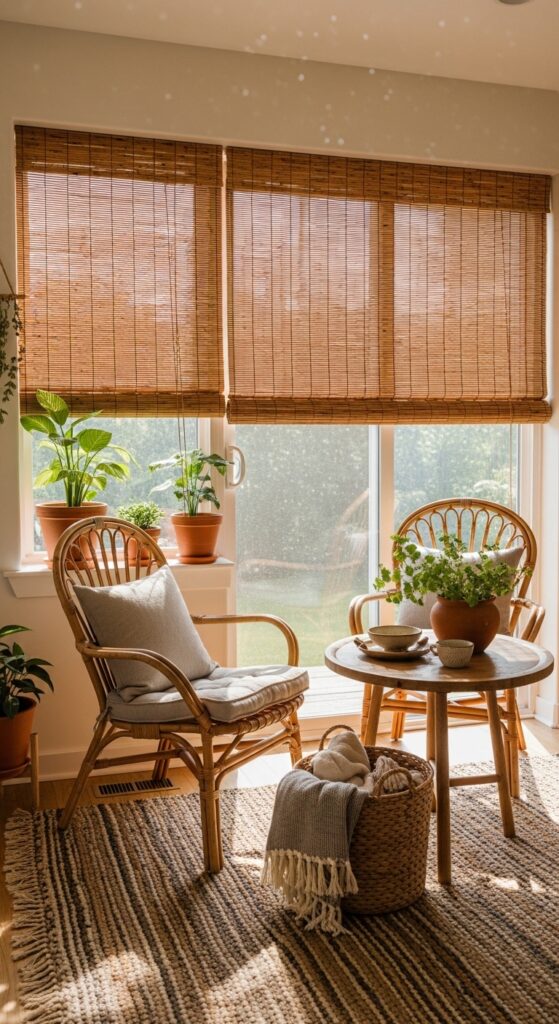
Best for: Boho, organic modern, or resort-inspired interiors
Woven bamboo, jute, and reed shades bring a layered, handcrafted quality that photographed interiors consistently feature — and for good reason. The natural fibers cast dappled light patterns on walls and floors throughout the day that change with the sun’s angle, creating an effect that feels genuinely alive.
The practical limitation to understand upfront: natural fiber shades do not provide privacy at night when interior lights are on. From outside, you become a clearly visible silhouette. For bedrooms or ground-floor living rooms facing neighbors, pair bamboo shades with a cellular blackout liner or a separate roller shade behind.
For wide sliding glass doors, bamboo shades often require two panels mounted side by side rather than a single continuous shade (most manufacturers max out at 72 inches for a single unit). The seam between two panels is visible up close but reads cleanly from across the room.
5. Motorized Smart Blinds — Technology Meets Total Convenience
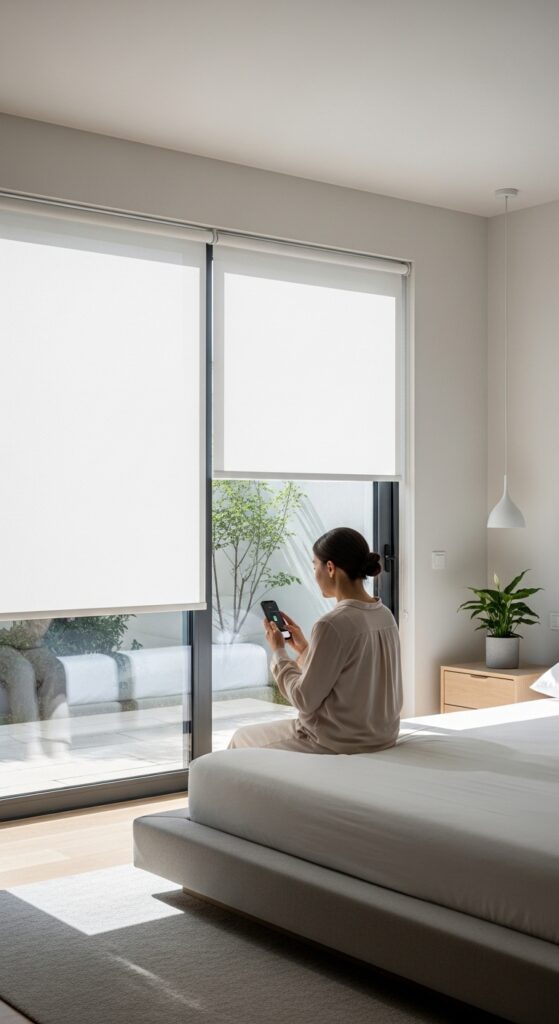
Best for: Tech-integrated homes, hard-to-reach doors, households with accessibility needs
Motorized blinds have crossed the threshold from luxury feature to reasonable upgrade — particularly with battery-powered options that require no wiring. Brands like IKEA FYRTUR (budget), Zebra Blinds (mid-range), and Lutron Serena (premium) now offer reliable systems at very different price points.
The honest value proposition: motorization is not just about convenience. For sliding glass doors on a solar-facing wall, programming shades to close automatically during peak sun hours (typically 11 AM to 3 PM) can reduce cooling costs meaningfully. It also prevents the UV fading on flooring and furniture that most homeowners notice only after years of damage.
Battery life varies significantly by brand and usage frequency. Expect 6 to 18 months per charge on most systems. Solar-charged models exist but require south or west-facing windows to charge reliably — direct obstructions like deep overhangs can leave them chronically low.
Integration with Google Home, Amazon Alexa, and Apple HomeKit varies by product. Confirm compatibility before purchasing if ecosystem integration matters to you.
6. French Door Curtains on a Bypass Rod — Romantic & Architectural
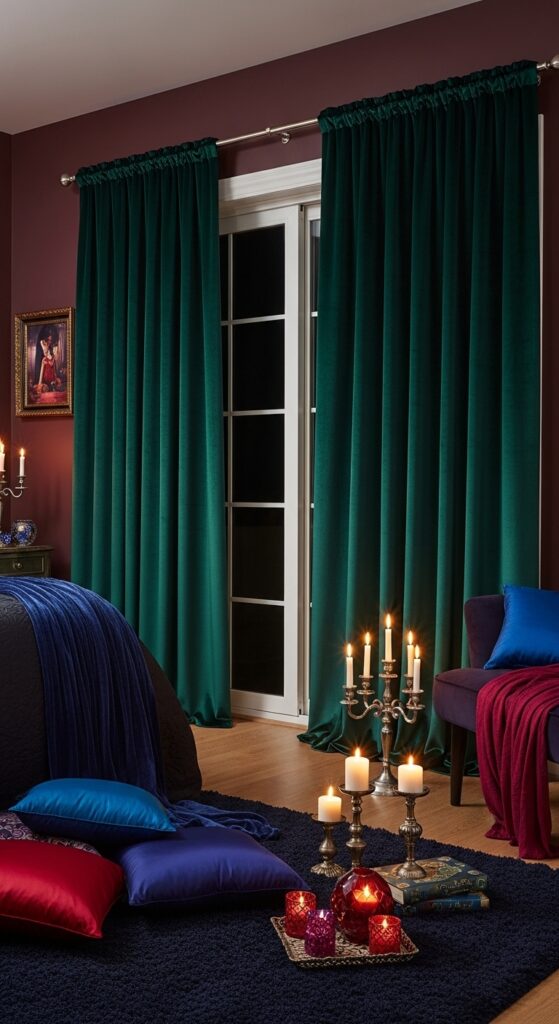
Best for: Bedrooms with balcony doors, romantic or traditional interiors
A bypass rod system uses two rods mounted at different depths from the wall, allowing two curtain panels to pass each other — one sliding in front, one behind. This is functionally different from a standard single-rod setup and solves a real problem: with a single rod, pulling one panel back to open the door forces all fabric to one side, which creates a visual imbalance.
With bypass rods, each panel moves independently. You can pull the left panel to the left when you open the door, keeping the right panel stationary — the visual balance holds, and the room looks intentional rather than improvised.
For maximum impact, choose floor-to-ceiling panels in a heavyweight fabric: velvet, cotton canvas, or thick linen. Let the fabric extend 1 to 2 inches past the floor for an upholstered, tailored look. Hem it cleanly — a ragged bottom hem destroys an otherwise well-executed installation.
7. Woven Wood Shades — Texture, Warmth & Artisan Appeal
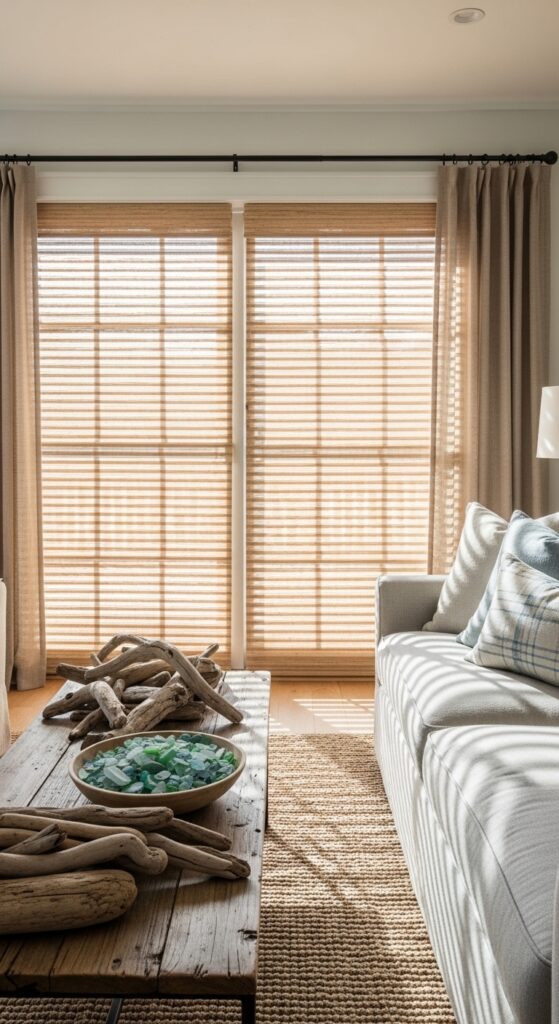
Best for: Mid-century modern, coastal, or globally-inspired interiors
Woven wood shades share some characteristics with bamboo roman shades but differ in one key way: the weave patterns are more intricate and the material choices broader — grasses, reeds, jute, and bamboo are often combined in a single shade. The result is a more dimensional, textile-forward look with stronger shadow patterning.
They mount and operate similarly to fabric roman shades, folding upward rather than rolling. The fold-up mechanism means they stack more visibly at the top when raised — typically 8 to 12 inches of stack height — which should be accounted for in your installation planning.
For a layered look that reads as deliberately designed, mount the woven shade inside the door frame and hang curtain panels on either side of the frame on a wider rod. The layering creates depth and makes the entire wall feel considered rather than piecemeal.
8. Blackout Roller Shades — Sleek, Simple & Totally Private
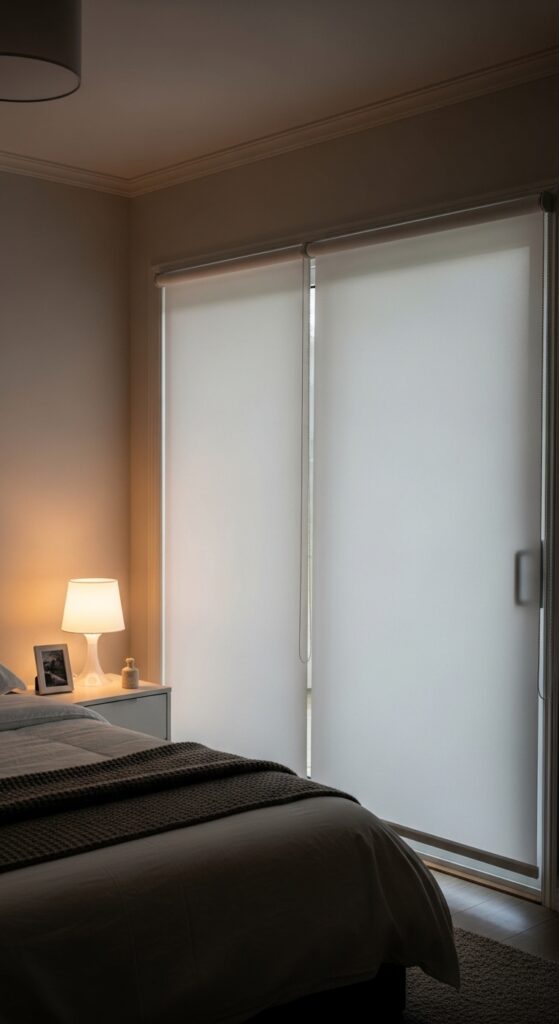
Best for: Bedrooms, media rooms, light-sensitive sleepers or workers
Roller shades are the clean-lines solution for people who value function over decoration. A quality blackout roller shade — one rated at 100% opacity, not 98% or 99% — eliminates all incoming light and provides complete visual privacy from the outside.
The installation detail that separates a premium look from a budget one: inside-mount versus outside-mount. Inside-mount shades sit within the door frame and create a recessed, architectural look. Outside-mount shades sit in front of the frame and better address light gaps at the edges. For bedrooms, outside-mount with a cassette that sits flush to the wall above is the most effective configuration.
Fabric texture matters more than most buyers expect. A crisp white roller shade in a linen-texture fabric reads as tailored and intentional. A shiny white fabric reads cheap. Run your hand across the sample — if it feels plasticky, it will look that way.
Maintenance is genuinely minimal: wipe with a damp cloth, spot-clean stains with mild soap. Do not use steam.
9. Velvet Curtains — Luxurious, Dramatic & Cozy
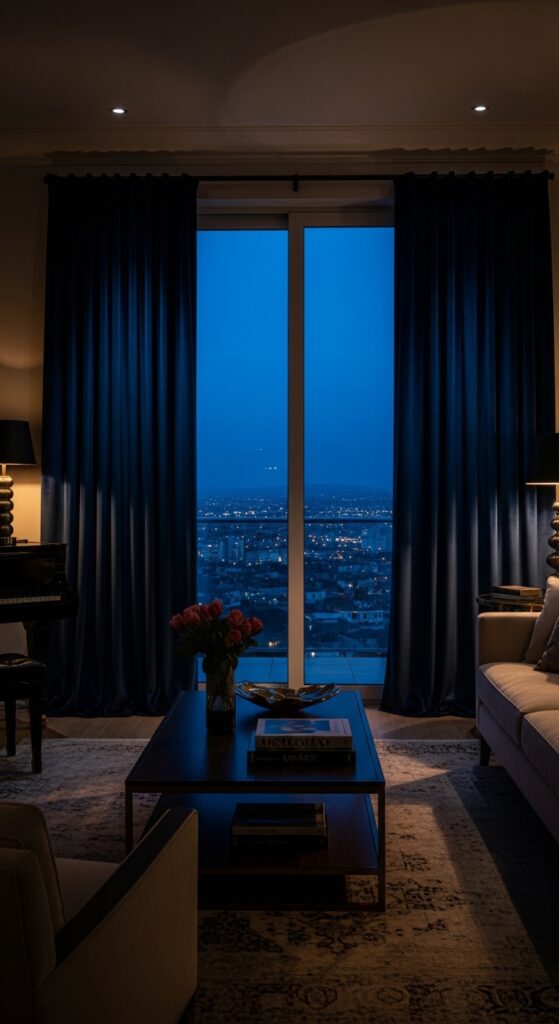
Best for: Formal living rooms, bedrooms, dramatic or maximalist interiors
Velvet has a specific acoustic and thermal property worth knowing: the pile absorbs both sound and heat transfer more effectively than most woven fabrics at similar weights. A pair of full velvet panels on a sliding glass door will noticeably reduce road noise and make a room feel warmer in winter — not by insulating the glass, but by eliminating the convective air movement that cold glass generates.
For installation, an oversized rod (1.5 inch or 2 inch diameter) suits the visual weight of velvet better than a slim contemporary rod. The proportions matter — a delicate rod under heavy velvet looks wrong in a way that is hard to articulate but immediately visible.
Velvet wrinkles in transit. When your panels arrive, hang them immediately rather than leaving them folded. Most wrinkles release within 48 hours of hanging. For stubborn creases, use a garment steamer held 6 inches from the fabric — never an iron directly on velvet, which crushes the pile permanently.
10. Bifold Barn Door with Shiplap Insert — Rustic, Charming & Unique
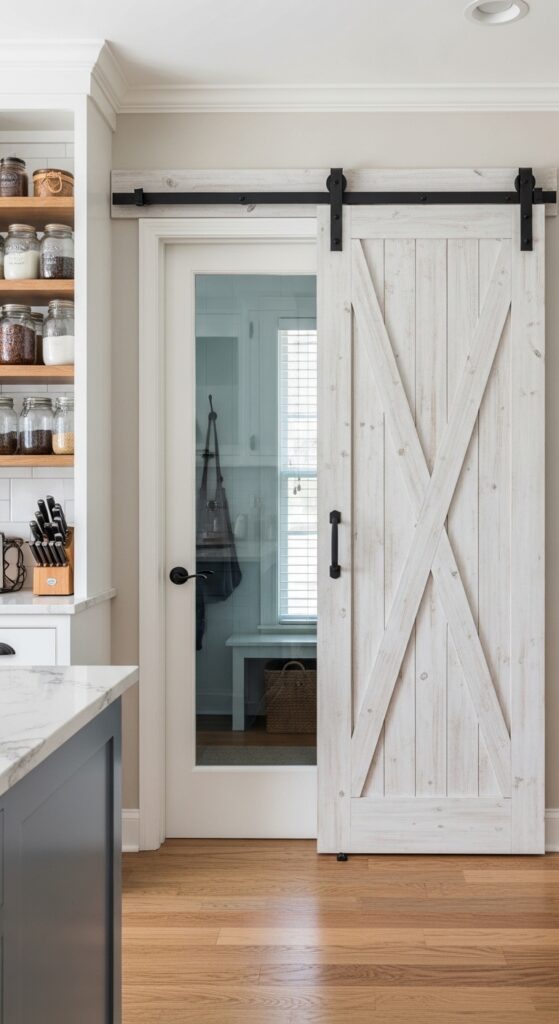
Best for: Farmhouse, rustic industrial, or transitional interiors
A bifold barn door panel is a hard covering — wood, metal, or composite — rather than a soft textile treatment. It slides on a wall-mounted track and folds against the wall when the glass door is in use. The result is architectural and permanent in a way that curtains and blinds simply are not.
The practical consideration: a bifold barn panel requires wall space equal to half the door width when folded open. For a 6-foot sliding glass door, you need approximately 36 inches of clear wall space beside the door. Before committing, measure carefully and account for any nearby switches, outlets, or furniture.
Material choice shapes the entire look. Weathered wood with black iron hardware is the farmhouse classic. Painted MDF in charcoal or white reads as contemporary. Whitewashed wood sits between the two aesthetically.
For privacy rather than full blackout, combine a semi-opaque or frosted glass insert in the barn door panel — you get the structural drama of the panel with some degree of light transmission.
11. Frosted Window Film — Budget-Friendly Privacy Without Blocking Light
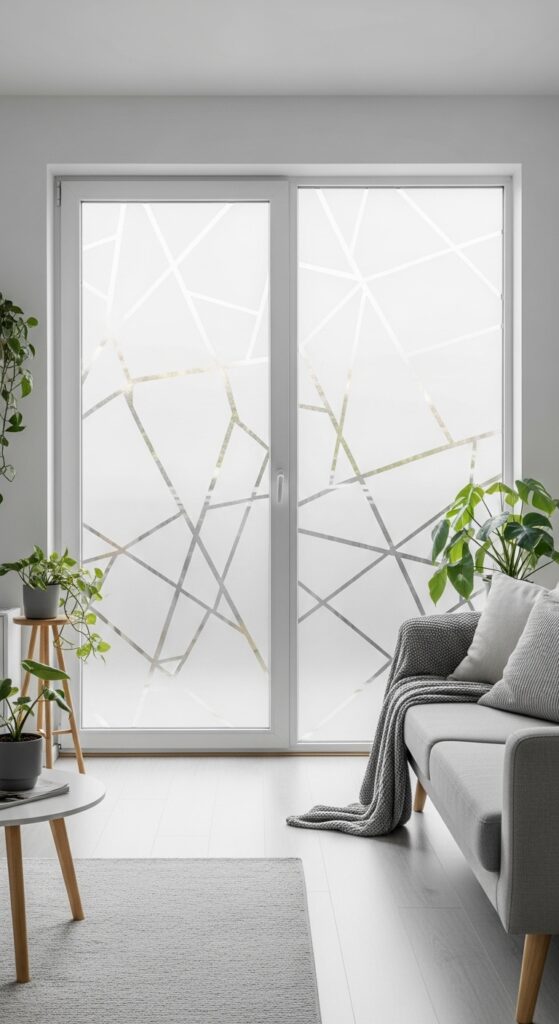
Best for: Renters, budget-conscious homeowners, privacy without darkness
Frosted window film is the most underrated option on this list. Applied directly to the glass surface, it creates a matte, light-diffusing layer that blocks the view from outside while transmitting a soft, even light throughout the day — no darkness, no bulk, no installation hardware.
The application process is achievable for most homeowners: clean the glass thoroughly, apply the film with a spray bottle of soapy water, squeegee out bubbles, and trim to size. A full sliding glass door can be covered in 45 to 90 minutes.
Removability varies by product. Most static-cling films pull off cleanly without residue. Adhesive-backed films leave residue that requires a razor scraper and solvent to remove — not ideal for renters. Confirm the removal method before purchasing.
Pattern selection now extends far beyond plain frosting. Geometric cut patterns, botanical etchings, and linear stripe designs are all available at $20 to $80 for a full door, making this by far the most affordable privacy solution on this list.
12. Layered Curtains with Blackout and Sheer — The Best of Both Worlds
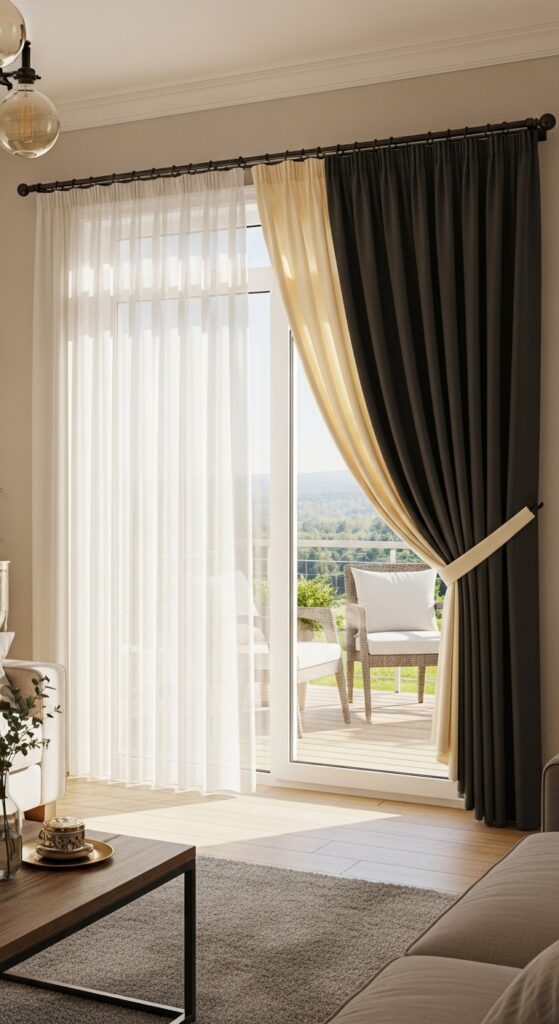
Best for: Living rooms and bedrooms where both day and night use are priorities
Layering a sheer panel with a blackout panel on a double curtain rod is the most flexible configuration for any sliding glass door. During the day, draw the blackout panel and close the sheer — diffused, private, beautiful. At night, close the blackout panel for complete privacy and darkness.
The design error most people make is choosing sheers and blackout panels in dramatically different colors or styles. The result looks accidental rather than intentional. Keep both panels within the same color family — warm white sheers with cream blackout, or soft gray sheers with charcoal blackout — and the layered system reads as a unified, sophisticated treatment.
Hardware matters: a double curtain rod with separate brackets for each layer is essential. The rods should be spaced at least 3 inches apart in depth so both panels can move independently without catching on each other.
13. Cellular (Honeycomb) Shades — The Energy-Efficient Champion
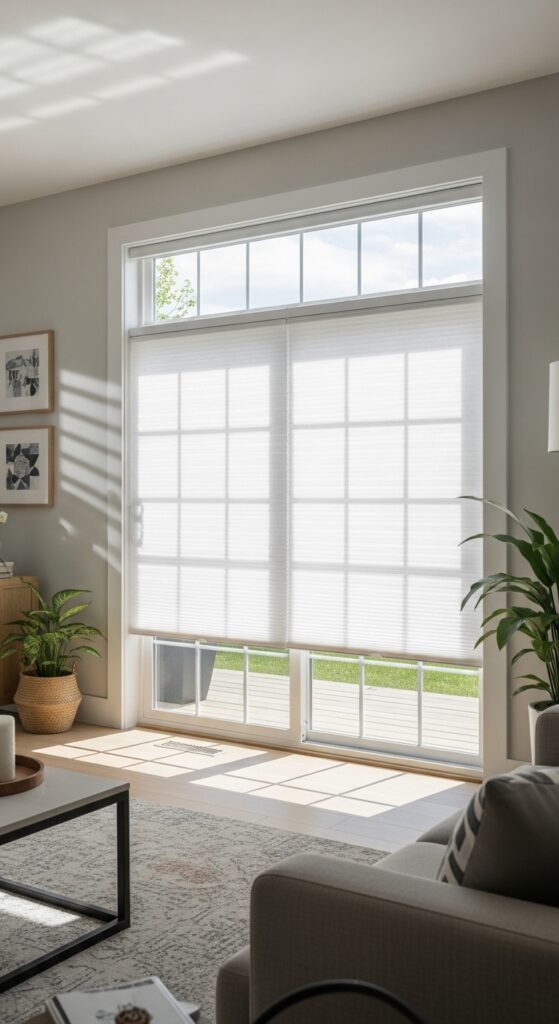
Best for: Energy-conscious homeowners, extreme climates, homes with high utility costs
Cellular shades have a structural advantage no other window treatment matches: air pockets within the cells create genuine thermal resistance. Double-cell configurations provide an R-value of approximately 3.5 to 4.5 — not transformative on its own, but meaningful when combined with other envelope improvements.
The top-down/bottom-up operating option is worth the upgrade cost for glass doors that face neighbors at a different elevation than you — you can raise the shade from the bottom for floor-level privacy while keeping the upper half open for sky light and views.
Cordless operation is the current standard and the right choice for homes with children or pets. Corded versions now feel dated and carry known safety risks.
Color selection affects thermal performance in addition to aesthetics: light-colored cellular shades reflect more solar heat gain in summer; darker shades absorb it. In cooling-dominated climates, lighter is better near south and west-facing glass.
14. Plantation Shutters — Timeless, Structural & Resale-Boosting
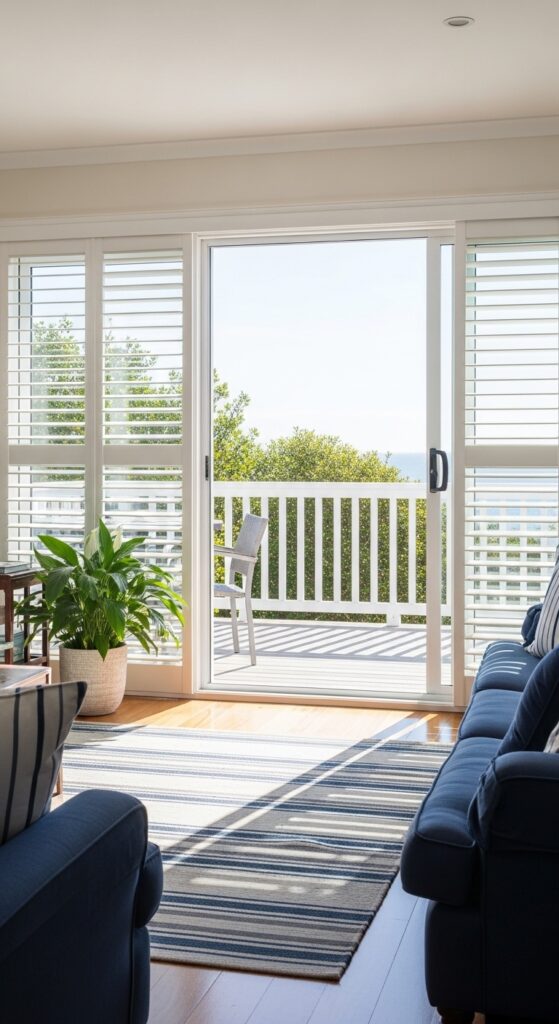
Best for: Permanent installations, coastal homes, homeowners prioritizing resale value
Plantation shutters are the only covering on this list that consistently adds measurable resale value to a home. Real estate professionals frequently cite interior shutters — particularly on prominent windows and doors — as a perceived-quality signal that buyers respond to positively.
The practical reason they work so well on sliding glass doors: wide louvers (3.5 inch or 4.5 inch) can be precisely angled to direct light upward toward the ceiling while maintaining privacy at eye level — a control option no soft treatment offers.
Bi-fold and bypass configurations both work for sliding glass doors. Bi-fold panels hinge open like a book and clear the door opening fully. Bypass panels slide on a track (similar to the door itself) and are better for very wide openings where folding would create excessive panel depth.
Material matters for durability: real wood shutters expand and contract with humidity and are not appropriate for coastal or high-humidity environments. Composite shutters resist moisture and maintain their finish in conditions where wood would warp.
15. Macrame or Woven Wall Hanging — Boho Art Meets Functional Privacy
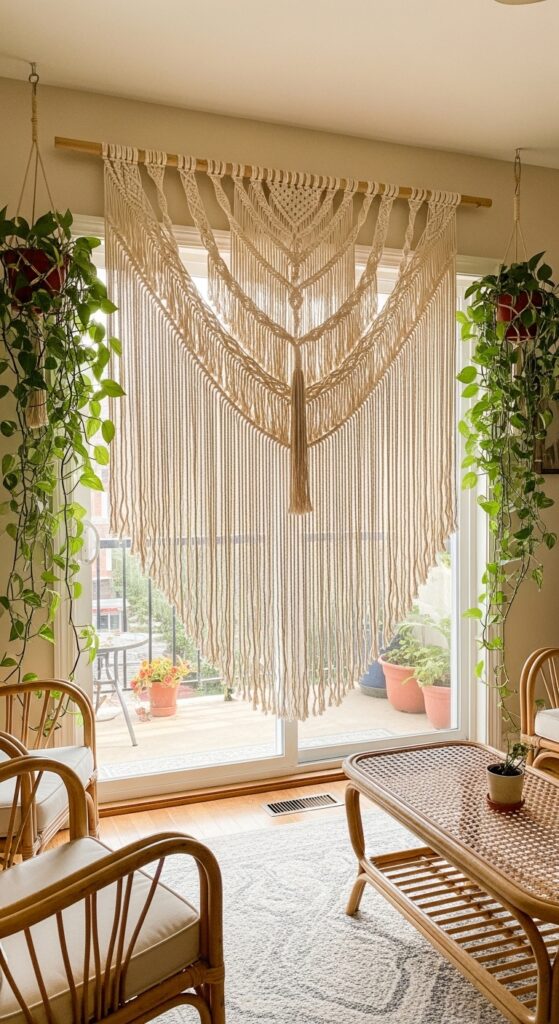
Best for: Bohemian, studio, or rental interiors — partial privacy as an artistic feature
A large-format macramé or woven textile hung above the glass door on an oversized dowel addresses privacy in a different way than any other treatment: not by blocking the view, but by layering the visual plane so the door reads as an interior feature rather than an exterior opening.
This is not a solution for complete privacy. Anyone close to the window will see through the open weave. But at distance — across a yard, from a neighbor’s window, from the street — the texture disrupts the view enough to matter. For ground-floor interiors that don’t face direct sightlines, it is functionally adequate and visually distinctive.
The scale must be proportional to the door. A piece that does not span at least 80% of the door width will look like a decorative afterthought rather than an intentional installation. Most artisan pieces available through Etsy and similar markets can be commissioned at custom widths for $80 to $300 depending on complexity.
16. Printed Patterned Curtains — Bold, Personality-Packed & Eye-Catching
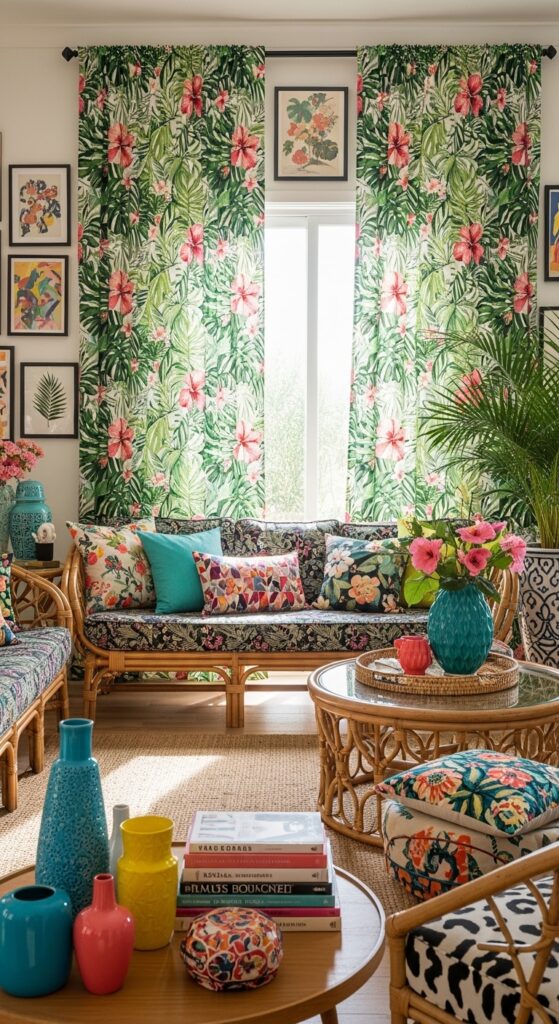
Best for: Rooms needing a visual anchor, personality-forward interiors
A printed curtain functions differently from a solid one: it becomes the focal point of the room rather than the background. This is either an asset or a liability depending on how your existing decor is organized.
When it works: in rooms with minimal furniture, neutral walls, and few competing patterns, a large-scale botanical, geometric, or abstract print on floor-to-ceiling panels gives the room a decisive visual center that ties everything together.
When it doesn’t: in rooms already carrying multiple patterns (tiled floors, patterned rugs, upholstered furniture), adding a large-scale curtain print creates visual noise that registers as chaotic rather than layered.
Scale matters within the print itself. Large repeats (12 inches or more) read well on wide glass doors. Small repeats — particularly geometric or check patterns — can create optical vibration at the scale of a full-width curtain treatment.
17. Stained Glass Window Film — Artsy, Colorful & Utterly Unique
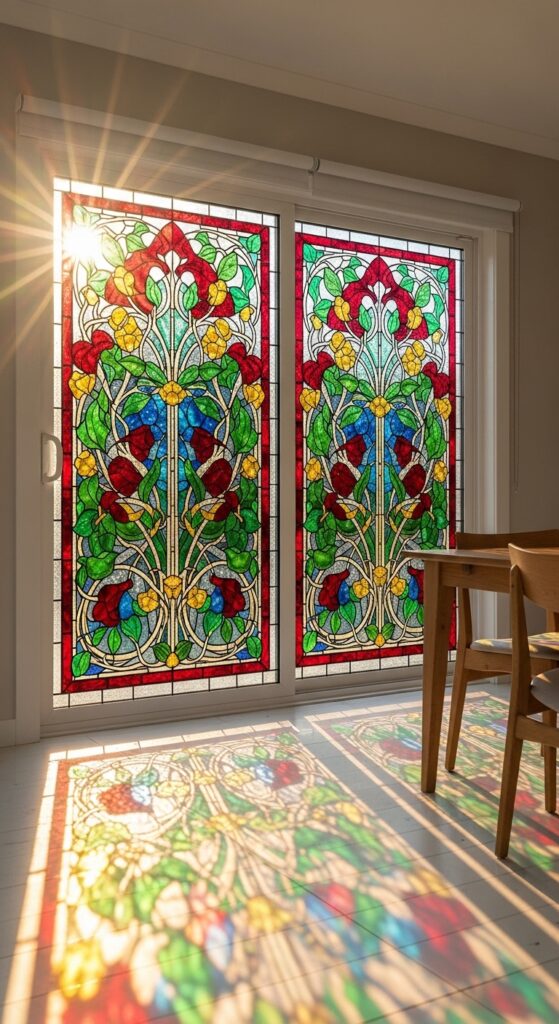
Best for: Renters, artistically inclined homeowners, rooms that can support color drama
Stained glass film is the most transformative option per dollar on this list. Applied as a static-cling decal, it refracts incoming sunlight into colored patterns across your floors and walls that shift as the sun moves — a kinetic visual effect that cannot be replicated by any other covering at this price point ($30 to $120 for a full door).
The design commitment is significant. Jewel-toned light patterns on your floor are arresting when you love them and exhausting when you do not. Before purchasing, tape a swatch of the film to your window for a week and observe how the light plays in your specific room at different times of day.
For a version with visual impact but less color drama, amber gradient films add a warm, golden cast to incoming light without the full rainbow effect. These work well in spaces where you want warmth without vibrancy — a meditation room, a reading nook, a home office.
FAQs: Expert Sliding Glass Door Solutions
Conclusion:
A sliding glass door is one of the most architecturally significant openings in a home — and the right covering transforms how the entire room functions and feels. The options above range from a $25 DIY film application to a $2,000+ plantation shutter installation, with genuine merit at every price point.
The most important principle: match the treatment to your actual priorities, not to what photographs well. A stunning velvet panel that you pull closed once a month is a beautiful waste of money. A simple blackout roller shade that you use twice a day, every day, is a genuinely excellent investment. Identify what you need the covering to do — and let that drive the decision.
2 thoughts on “17 Sliding Glass Door Covering Ideas”